

AB Dynamics has released an updated version of its Special Groups library, which enables the automation of more than 1,200 tests included in the new Euro NCAP 2026 protocols. The company says the automated tests can potentially save test teams months of development time.
The update, which is available as an optional upgrade through the latest version of the company’s Track Applications Suite, represents the largest expansion of Euro NCAP scenarios in the library to date. The Special Groups library provides preconfigured test scenarios that automate the testing and validation of industry-standard active safety and driver-assistance protocols.
According to Liam D’Souza, senior verification and validation engineer at AB Dynamics, the scale of the new Euro NCAP protocols presents considerable challenges for testing teams. “There are now more than 1,200 different test scenarios to contend with, not to mention the other regional NCAP and type-approval protocols that test teams must also navigate,” he said. “Designing, calculating and running these tests manually is incredibly labour-intensive. We have done all the hard work for our customers and are saving teams months in time.”
A notable development in the Euro NCAP 2026 protocols is the introduction of robustness testing. Unlike traditional test methods, which are highly prescribed, robustness testing establishes a base scenario while allowing test facilities to introduce variations – such as speed or offset – to replicate the unpredictability of real-world driving conditions.
The tests in the Special Groups library are fully configurable, enabling customers to extend testing beyond prescribed Euro NCAP requirements and conduct their own robustness assessments.
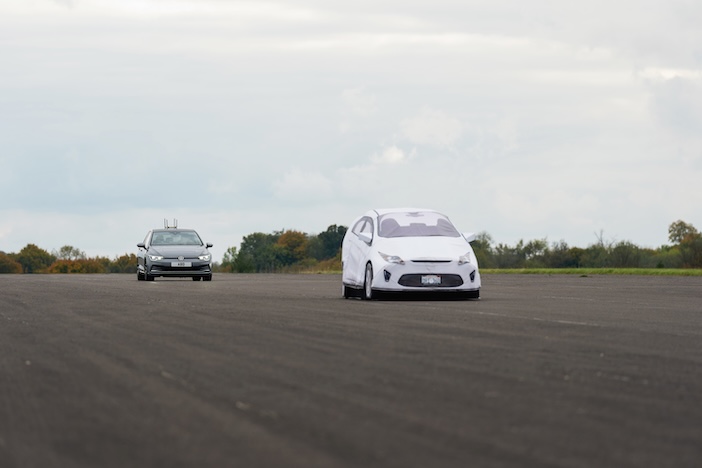
The updated library includes head-on collision scenarios, such as the Car-to-Car Front Head-On Straight (CCFhos) and Car-to-Car Front Head-On Lane Change (CCFhol). The highest-speed tests feature closing speeds of 200 km/h (124 mph), so accuracy is critical to ensuring valid test data.
“The head-on scenarios represent some of the riskiest tests manufacturers face,” said D’Souza. “Euro NCAP considers a 20 km/h reduction in collision speed a pass. As a result, even successful tests can involve an aggressive collision and potentially cause damage to the test vehicle and equipment. Automating these tests helps to de-risk this scenario.”
The software integrates with a suite of ADAS testing tools, including driving robots, telemetry systems, ADAS objects and platforms.