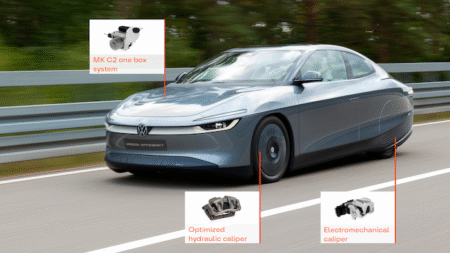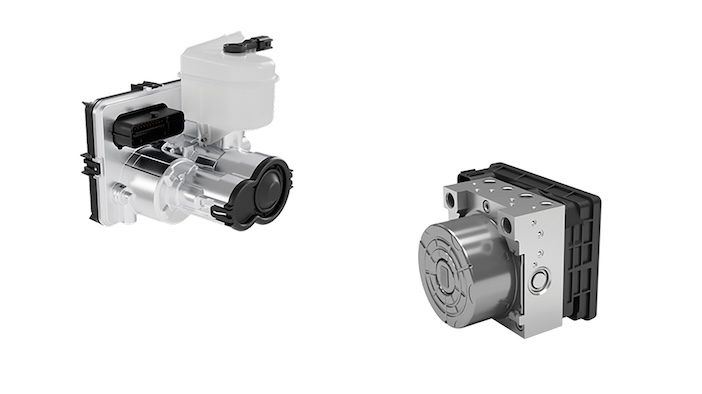
Aumovio, a German automotive technology company, has developed a compact distributed brake system that combines an advanced one-box electrohydraulic brake with an Electronic Stability Control (ESC) system.
The distributed brake system operates fully electronically from the brake pedal through to the fallback level and makes use of modern electrical/electronic (E/E) architectures. This setup allows for the two actuators to be smaller and lighter, and in turn enables a more compact design, which frees-up installation space for hardware such as a larger high-voltage battery and also enables more flexible options for actuator placement in the vehicle.
Aumovio says the distributed brake also delivers greater performance than previous one-box systems, making it suitable for demanding applications such as highly automated driving.
The first order for the system has already been secured, from an unspecified ‘major Chinese vehicle manufacturer’, with production scheduled to start at the end of 2027.
Intelligent redundancy
Most one-box brake systems for highly automated driving (HAD) contain two brake actuators, but only one is used during normal operation, with the second actuator serving as a fallback.
Aumovio’s distributed brake system is different as it keeps both brake actuators permanently active, allowing them to generate the braking force together when required. Each braking system is designed to function independently in the event of a fallback.
This enables a distributed brake system to be made smaller, lighter, and more energy-efficient compared to more conventional one-box systems. By coordinating the actuators, braking performance can be enhanced compared with predecessor models, both in normal driving and in emergency mode.
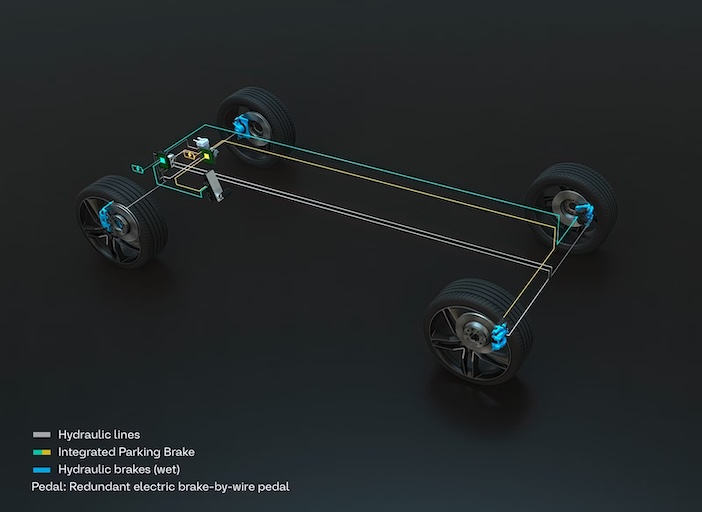
One reason for this increase in performance is that while most braking systems act on only two or three wheels in fallback mode, the distributed brake system continues to access all four wheels. This makes the system suitable for highly automated driving, where safety in the event of an electrical failure is crucial. Aumovio says that distributed brake systems can be used for automated driving up to SAE Level 5.
Leveraging modern E/E architectures
The E/E architecture of modern vehicles has been leveraged for the distributed brake system. The system includes multiple power supply points and redundant electrical networks. This architecture meets the requirements for braking systems without a hydraulic fallback, which must be equipped with a redundant system that includes its own electrical circuit.
Since the driver’s braking commands are transmitted electrically in the system, and no hydraulic fallback with a mechanical connection to the driver is required, almost all braking system components – except for the electronic brake pedal – can be positioned freely in the front section of the vehicle. This flexibility supports new vehicle concepts and enables optimised use of installation space, for example through the use of larger batteries that extend vehicle range.
The distributed brake system is suitable for many different vehicle types, such as fully electric and hybrid vehicles, and new combustion-engine vehicles equipped with such redundant E/E architectures.
An efficient e-pedal concept
The absence of a mechanical-hydraulic connection between the brake pedal and braking system in the distributed brake system provides further benefits. For example, the air gap between the brake disc and brake caliper can be increased because brake pressure in the fallback level is built up electronically with precision and speed. This reduces unwanted friction between the brake disc and brake caliper.
At the same time, a single e-pedal braking system can be used for a wide range of vehicle architectures. Instead of slightly different variants, for example for left- or right-hand drive, combustion-engine or electric vehicles, all vehicles can be equipped with the same e-pedal braking solution. This flexibility reduces the number of variants and helps lower the costs of development, manufacturing and logistics for both suppliers and car manufacturers.