MathWorks has released the latest versions of its MATLAB and Simulink software, adding new products for managing product variants, developing visual inspection applications, and automating the testing of embedded software.
Release 2026b (R2026b) introduces Simulink Variant Manager, Visual Inspection Toolbox and Polyspace Test Server, alongside updates to existing tools covering embedded systems, artificial intelligence (AI), perception, aerospace, audio engineering and statistical analysis. According to MathWorks, the release is aimed at engineering teams developing systems that increasingly combine software, electronics and AI.
Simulink Variant Manager is designed to handle growing numbers of product variants across complex models and system architectures. MathWorks says the tool improves consistency, traceability and collaboration during development, supporting work on product families and platform-based designs.
Polyspace Test Server automates testing and code coverage analysis for C/C++ embedded software within continuous integration environments. Engineers can run unit and integration tests and carry out structural coverage analysis on automation servers, which the company says supports compliance and reduces manual verification effort.
Avinash Nehemiah, head of product management and marketing – design automation at MathWorks, said, “Engineering organisations are being challenged to deliver increasingly sophisticated products that blend software, AI, electronics, and connected systems while maintaining quality, compliance, and development speed.”
Further developments
Visual Inspection Toolbox combines AI and image-processing techniques for developing and deploying visual inspection applications in manufacturing and industrial environments. The release also adds Point Cloud Toolbox, which extends workflows for LiDAR, camera, radar and simultaneous localisation and mapping (SLAM) applications in robotics, automation, transportation and other sensor-driven fields.
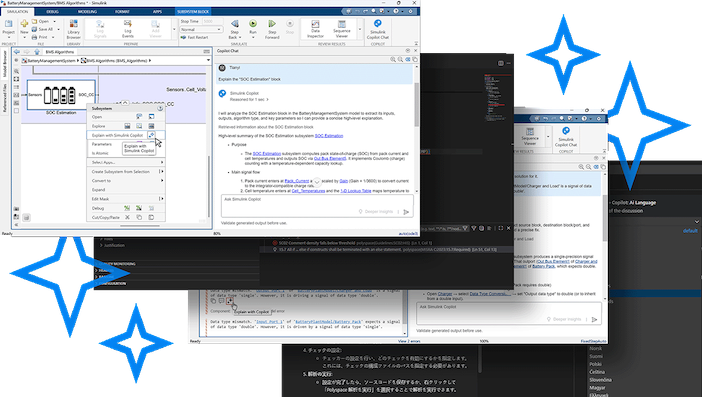
Within Simulink, published models can now be reused without rebuilding, while data dictionaries based on JavaScript Object Notation (JSON) are intended to support source-control workflows. The update also introduces AI-assisted profiling insights generated with Simulink Copilot.
Simulink Design Verifier now distributes analysis across multiple central processing unit (CPU) cores to accelerate verification, and MathWorks says precision has improved for models that use floating-point and complex mathematical operations. The Statistics and Machine Learning Toolbox gains interactive applications for design of experiments and gage repeatability and reproducibility studies, used to evaluate measurement-system variability and analyse experimental results.
MATLAB itself gains project files based on Tom’s Obvious Minimal Language, package management through File Exchange, Google Sheets integration, and performance improvements for data-centric workflows. In Deep Learning Toolbox, a new Time Series Modeler app is intended to simplify time-series AI workflows, while PyTorch models can now be co-executed in MATLAB and Simulink.
Hardware-software co-design for AMD adaptive system-on-chip (SoC) devices and field-programmable gate arrays (FPGAs) is extended through the SoC Blockset for AMD, covering communications, vision, deep learning and control applications.