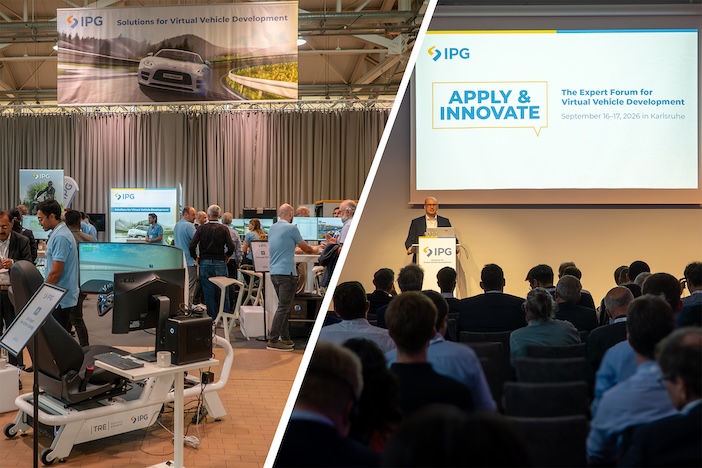
Experts from the automotive and supplier industries, as well as from research institutions, met in Karlsruhe, Germany for the Apply & Innovate event hosted by IPG Automotive on 16-17 September.
The event was designed to offer insights into current developments in virtual vehicle development and share examples of practical applications. Special emphasis was put on software-defined vehicles, ADAS and automated driving, virtual verification and validation, as well as data-driven development and artificial intelligence (AI).
IPG Automotive was heartened to see that the event had already set a new record prior to its opening, with over 300 registrations made in advance. The two-day technology conference featured 36 presentations focusing on current development approaches and research results. Topics included shift left, continuous virtual validation, automated test processes, and the increasing use of virtual methods in vehicle development.
Event highlights
Ulrich Schulmeister from Robert Bosch GmbH and Klaus Hassel from Dr. Ing. h.c. F. Porsche AG held the first keynote speech. Their presentation titled ‘A New Way of Collaboration Between OEM and Tier 1 to Push Virtual Development’ shed light on OEM and Tier 1 collaboration and its significance for the advancement of virtual development processes.
Further presentations showcased practical approaches for vehicle function validation and the development of software-defined vehicles.
Data-based approaches to model customer behaviour, the generation of simulation-capable scenarios, and the use of generative AI in virtual validation were other topics covered during the event. In addition, experts presented Cloud-based simulation environments as well as continuous scenario-based validation chains for ADAS and AD systems.
The evening event featured a keynote by Dr Manaswini Rath from KPIT Technologies titled ‘Building Trustworthy Autonomy and End-to-End AI with World Foundation Model’, which highlighted the use of AI for credible automated systems. During the evening event at the Gartenhalle, a glazed hall in the Karlsruhe convention centre, attendees also had the opportunity to deepen technical discussions from the first conference day in a relaxed atmosphere.
On the second day of the expert forum, Pierre-Marie Damon from Euro NCAP gave a keynote speech titled ‘Virtual Testing in Euro NCAP: Current Status and the 2029 Vision’, which explored how virtual tests can be linked more closely to established assessment methods in the future.
Damon provided insights into the current status of virtual testing at Euro NCAP as well as an outlook up to 2029. Complementing this topic, multiple presentations focused on virtual validation of ADAS functions in the context of Euro NCAP as well as on vehicle and ambient condition modelling for simulation-based tests.
As well as the presentation programme, Apply & Innovate offered opportunities for networking and discussion. An accompanying trade exhibition, guided tours and demonstrations at IPG Automotive’s site in Karlsruhe rounded off the conference programme.
Steffen Schmidt, president & CEO of IPG Automotive, said of the event: “Vehicle development faces the task of validating increasingly complex systems faster and more reliably. Apply & Innovate shows that virtual development methods contribute significantly to this aim and highlights how important in-person discussions about practical applications and experiences are.”