Aumovio, a German automotive technology company, Technology company AUMOVIO has equipped Volkswagen’s ‘Mission Efficiency’ a near-production four-seat electric concept car is designed to maximise vehicle range through advanced aerodynamics and lightweight design rather than simply adding a larger battery.
The aim of the concept is to create the world’s most efficient near-production electric car and highlight the potential of Volkswagen’s next generation of electric models.
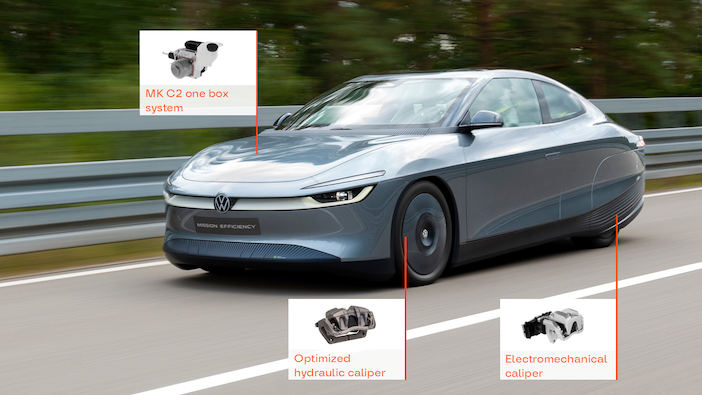
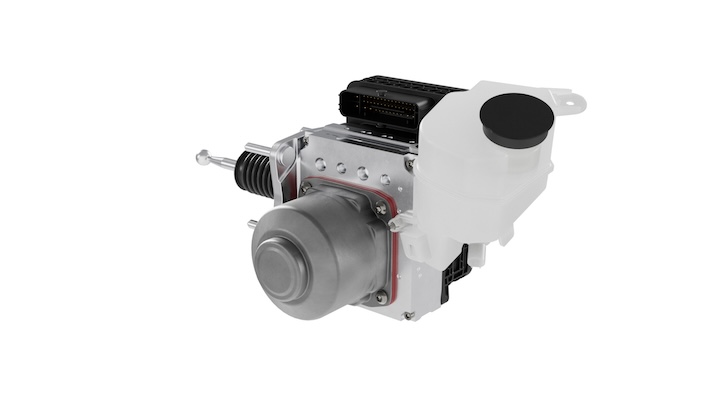
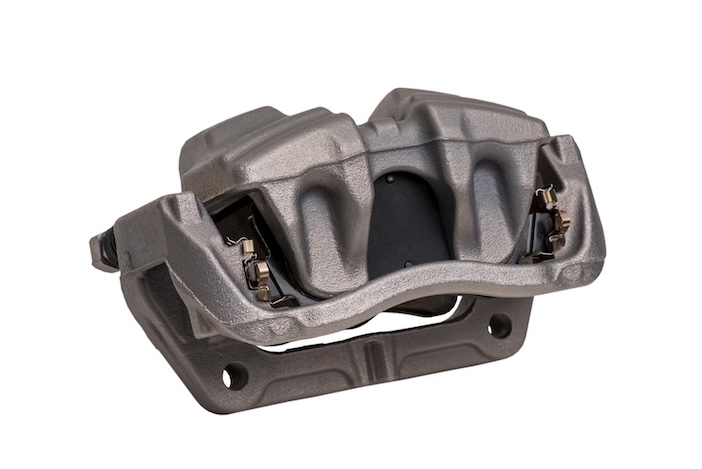
The concept includes a semi-dry braking system that combines the latest hydraulic and electromechanical brake technologies to tailor the brakes specifically to the requirements of electric vehicles. The current generation of the MK C2 one-box system from Aumovio, optimised for regenerative braking, is used on the front axle, together with optimised hydraulic brake calipers.
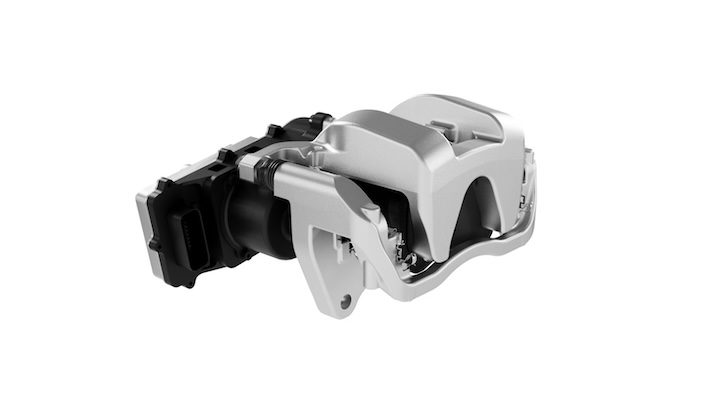
The rear axle is fitted with a near-production electromechanical brake (EMB). Compared with the production version, the air gap – the distance between the brake disc and brake pad – is larger on both axles. This further reduces unwanted friction in the wheel brakes.
Reduced residual braking torque on the front axle
Aumovio already supplies the MK C2 system and the front-axle brake calipers for the in-series ID.Polo model, designed to support regenerative braking. As a so-called brake-by-wire solution, the system transmits the braking command electronically and is therefore completely decoupled from the hydraulic system. Unlike electric brake boosters, which are still connected to the hydraulic system, this allows for regenerative braking without friction losses.
In order to minimise the loss of kinetic energy, the system decides on its own whether to engage the friction brake or whether the braking command should be used to recover energy via the electric generator. In the Mission Efficiency concept vehicle, Aumovio has also optimised the hydraulic front axle caliper. Compared to the series model, this caliper can build up a larger air gap more quickly, thereby minimising residual braking torque.
A semi-dry brake system with a consistently large air gap
A new feature compared to the standard braking system on the ID.Polo is the electromechanical brake setup on the rear axle. Instead of hydraulic pressure (‘wet’ brakes), the brake calipers are actuated by an electric motor (‘dry’ brakes) and therefore do not require hydraulic lines or brake fluid.
The faster electromechanical actuation means that the air gap can be increased compared to the brake calipers on the front axle, which further reduces residual braking torque. Another advantage of the electromechanical design is that the air gap can be actively adjusted via the electric motor, ensuring it remains constant.
After the electric parking brake is applied or high braking forces are applied, the caliper is deliberately reopened, regardless of the previous application. Unlike with hydraulic brakes, there is no ‘memory effect’ with an initially increased residual braking torque that would consume energy, even after heavy braking manoeuvres.
Potential for further optimisation: vehicle dynamics, weight and recuperation
According to Aumovio, the semi-dry brake system offers potential to enhance the driving dynamics performance of electric vehicles because the EMB can distribute brake forces dynamically and individually to each wheel. This further improves regenerative braking performance, increases vehicle stability (especially when cornering) and enhances braking comfort. This effect can be further amplified in a fully dry system with electromechanical calipers on all four wheels.
The EMB can also intelligently adjust the air gap to ensure situation-appropriate braking. When cornering, it increases the air gap to reduce residual braking torque. When hazardous situations are detected early, it reduces the distance between the brake pad and disc to bring the vehicle to a stop more quickly.
Since the semi-dry system for the rear wheel brakes requires neither hydraulic lines nor brake fluid, weight can be reduced depending on the model, and brake maintenance requirements are also reduced. At the same time, the EMB enables greater design flexibility in vehicle architectures.
A ‘smart sizing’ concept for electric vehicles
One example of an optimised hydraulic application is the ‘smart sizing’ concept for brake calipers. To this end, Aumovio has refined the brake design to meet the requirements of electric vehicles, by streamlining and reducing the number of components. A smaller housing and an adjusted pad mass reduce the weight of the caliper.
The concept also allows for a greater air gap, thereby reducing the residual braking torque. Since the brake engages further outward on a larger, thinner disc, less clamping force is required to achieve the same braking torque.