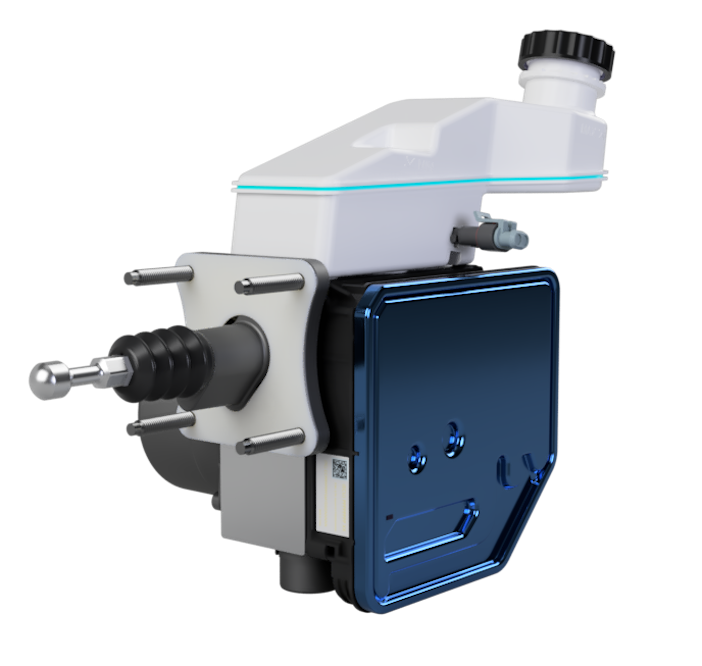
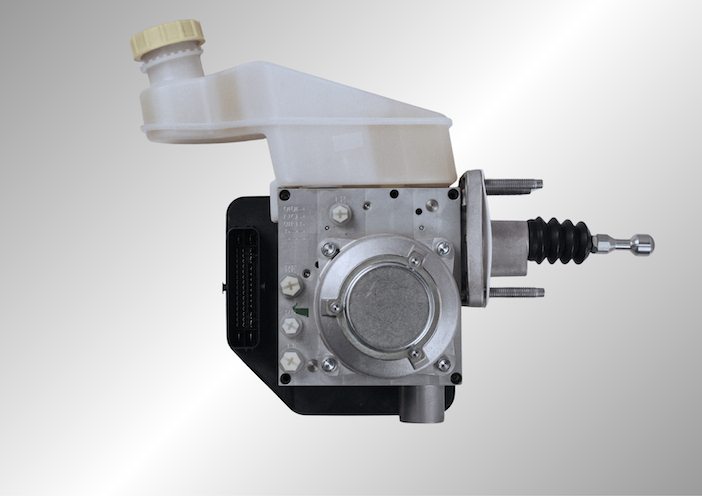
BWI Group, a supplier of automotive suspension and braking systems, has launched its integrated Dynamic Brake Control (iDBC) 1-Box system for EVs in the Europe market. The iDBC is an integrated electro-hydraulic system that replaces the conventional brake actuator and vacuum booster setup with a single compact unit.
With the iDBC, when a driver presses the brake pedal, the brake pressure does not transfer directly to the calipers. Instead, a pedal travel sensor and a pressure sensor communicate the driver’s intention to the electronic control unit (ECU), which commands a motor in the pressure supply unit (PSU) to build the required hydraulic pressure for the brake calipers.
BWI claims the iDBC builds brake pressure around three times faster than a conventional vacuum-boosted brake actuator, which aids the rapid interventions required by automatic emergency braking and other advanced driver assistance functions.
The decoupling of the brake pedal from the calipers also eliminates the pedal vibration drivers feel under ABS activation, supports a tuneable pedal feel that OEMs can match to their brand, improves overall NVH, and provides the architectural foundation for system redundancy in highly automated driving.
“The vehicle chassis is becoming a digitised, software-controlled system, and the brakes are no longer a discrete mechanical assembly but a programmable subsystem,” explained Andrea Ciavolino, TPL and product manager at BWI Group.
“That shift opens up a level of tuneability and refinement that was simply not available with conventional vacuum-boosted hardware. Pedal feel can be calibrated to an OEM’s preference, regenerative and friction braking can be smoothly blended, and the system can be refined further across the lifecycle of the vehicle.”
A full software stack
The iDBC is delivered as a turnkey package. The hydraulic unit, valves, electronics, base software and every control function have been developed in-house by BWI Group. This includes the stability functions (ABS, electronic stability control, traction control), the advanced driver assistance functions (hill hold, electric parking brake, automatic emergency braking, adaptive cruise control with stop-and-go), and the regenerative braking, one-pedal drive, and driver brake alert algorithms.
System validation and safety
As an ASIL-D (Automotive Safety Integrity Level D) system, the iDBC has been designed for fail-safe operation. A direct hydraulic path from the brake pedal pushrod to the calipers acts as a mechanical backup, ensuring that braking remains available to the driver in the event of an electronic system failure. BWI’s development team have built every engineering function, from implementation through application to validation, around that requirement.
“Brakes are one of the most safety-critical systems on any vehicle, so every engineering decision flows from that,” added Ciavolino. “We designed the iDBC so that the driver always retains the ability to stop the car, even under a fault condition that disables every electronic system on the vehicle. The mechanical hydraulic path is the final line of defence.”
BWI Group has validated the iDBC across the operating conditions a passenger vehicle is expected to encounter in service, including high- and low-temperature testing and a full winter programme on ice and snow at BWI Group’s low-adherence facility in Arjeplog, northern Sweden.