Yokohama Rubber has developed and begun full-scale operation of a proprietary generative AI system that uses RAG (Retrieval-Augmented Generation) to search various internal technical documents and present responses based on their contents. This system is designed to provide rapid and accurate access to the necessary technical information for decision-making during the tyre development process, including the materials development stage.
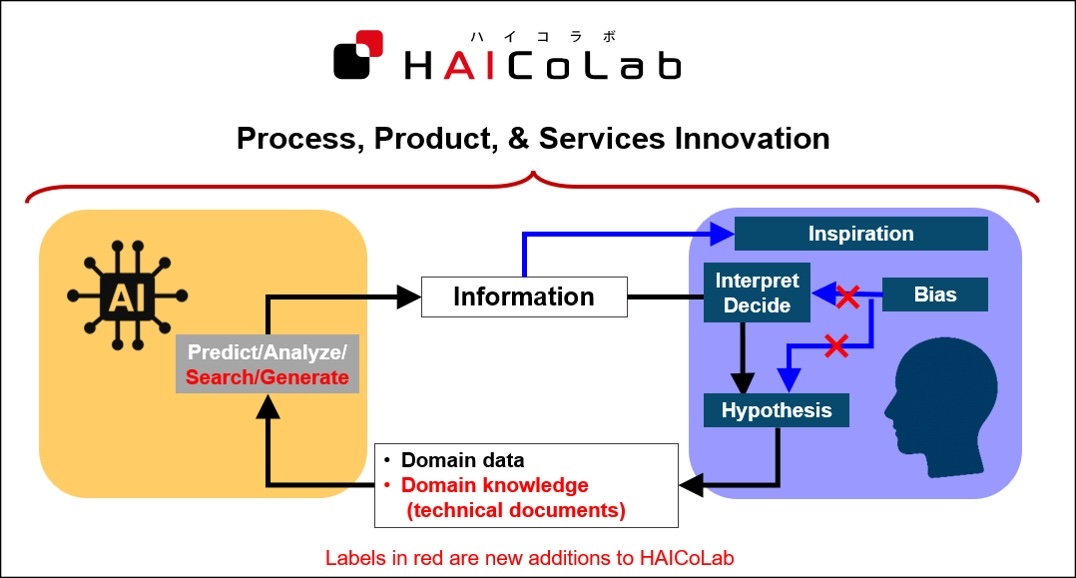
Yokohama Rubber developed this system to expand the practical environment of its proprietary HAICoLab AI framework, which was established in October 2020. HAICoLab is a framework designed for collaboration between humans and AI that drives a virtuous cycle of innovation in products, processes, and services alongside human growth.
The process starts with enhancing AI by using data and knowledge accumulated in the company, the formulation of hypotheses by humans using metacognition, and the development staff then interpret and judge the results using the enhanced AI system.
Yokohama Rubber has previously developed AI systems that predict the physical properties and characteristics of a rubber compound, generate new compositions of rubber compounds, and support the design of tyre moulds. The company is increasingly using data to create material and tyre designs.
The technical knowledge (also known as domain knowledge) that developers need to make decisions during the tyre development process can be found in a wide range of technical documents that include regulatory documents, procedural manuals, technical reports, and case studies.
Yokohama’s system can quickly search this vast collection of data and provide information appropriate to development objectives and circumstances, but the company notes that creating the system has been a challenge.
How it works
Development staff at Yokohama Rubber use the system to input questions tailored to the objectives of a development programme, and the generative AI then searches for the most relevant information found in internal technical documents and provides responses based on that content.
The staff have also created a mechanism by which an implemented AI agent ‘learns’ the intent of the staff’s questions and enhances the accuracy of its response by autonomously repeating the process of planning searches, retrieving information, and evaluating the results.
The system displays links to the original documents that serve as the basis for responses, so that development staff can verify the basis and appropriateness of those responses and use them in interpretation and decision-making. Yokohama says this process has added a mechanism that uses domain knowledge accumulated in technical documents with AI, thereby expanding the tyre development environment based on HAICoLab.
Along with the development of these AI systems, Yokohama Rubber is training DX (developer experience) staff in their use of HAICoLab, and is continuing to enhance the system’s capabilities.