

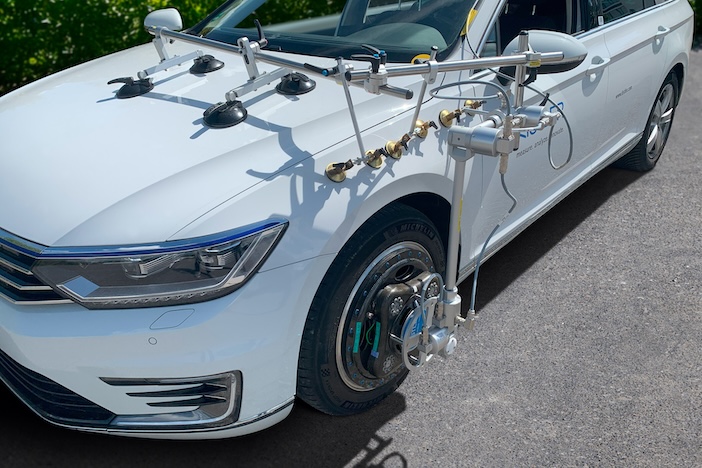
Kistler has introduced the RV-5 wheel-vector sensor, a redesigned five-axis measurement instrument that captures steering angle, camber angle, and translational movements in the X, Y, and Z directions with higher accuracy and greater robustness than its predecessor model.
Wheel position and orientation measurements underpin a wide range of chassis development tasks, including verification of wheel arch and component clearance, validation of simulation models for elastokinematic analysis, and development of tyres and suspension systems. Stable, reproducible measurements are particularly critical in motorsports and vehicle dynamics control applications such as electronic stability control (ESC), torque vectoring, and advanced driver assistance systems (ADAS).
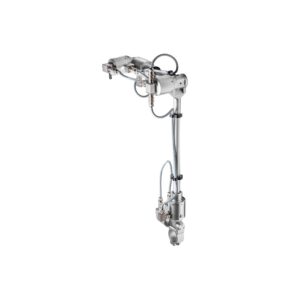
The redesigned system of the RV-5 replaces the optical encoders used in the outgoing RV-4 model with magnetic encoders, delivering higher signal linearity and stability, lower noise, and improved resolution. Kistler says this redesign allows smaller changes in angle and displacement to be captured, and produces smoother raw signals that require less filtering and are available at lower latency.
The RV-5 connects directly to the wheel-carrier structure and measures wheel vectors at the source, without requiring a line of sight, image processing, surface textures, or markers. Measurements remain stable and reproducible in rain, dust, splash water, and abrupt lighting changes – including where wheels are partially or completely covered by fairings within the wheel arch.
Factory calibration in the vehicle coordinates system remains stable across temperature and vibration changes, removing the need for recalibration, as required with some camera-based setups. The sensor is also insensitive to optical artefacts and continues to deliver consistent and precise low-latency data on rough roads, over kerbs, and under high lateral and vertical accelerations.
The RV-5 is fully drop-in compatible with the RV-4, with installation, operation, and interfaces unchanged. Setup is performed using the KiCenter software, allowing existing test procedures, scripts, and evaluations to continue without modification. Mixed configurations comprising RV-5 sensors with magnetic encoders alongside RV-4 units with optical encoders are also supported, and Kistler offers service upgrades to convert existing RV-4 sensors to magnetic encoder technology.
“Magnetic encoders make our wheel vector sensors even more robust and precise without disrupting customers’ established setups,” said Oliver Plenter, business development manager at Kistler.
The RV-5 is available in versions for passenger cars and trucks and can be ordered as a standalone sensor, with evaluation electronics, or with a wheel pulse transmitter (WPT) that also provides lateral wheel angle and wheel speed data.