A feasibility study commissioned by WorldAutoSteel reports that that modest assembly line changes combined with the increased use of advanced high-strength steels can reduce the parts count of vehicle front body structures by up to 34% and cut total manufacturing investment costs by US$21 million.
WorldAutoSteel, an automotive steel producer, tasked Ricardo, a specialist in automotive technology development, to create a virtual front body structure concept using the Steel E-Motive vehicle concept as the baseline reference. The study aimed to address how parts consolidation can be achieved at scale without compromising safety, performance, or manufacturability, particularly for battery electric vehicle (BEV) platforms.
Using WorldAutoSteel’s ‘Steel E-Motive’ concept as the base, the project partners say the new design reduced parts count in the front structure from 38 to 25. The reduction of 13 parts also created a weight saving of 8% and a reduction in piece cost of 10%. The reductions were achieved by consolidating individual parts into larger single hot- and cold-stamped components, often incorporating more complex geometry.
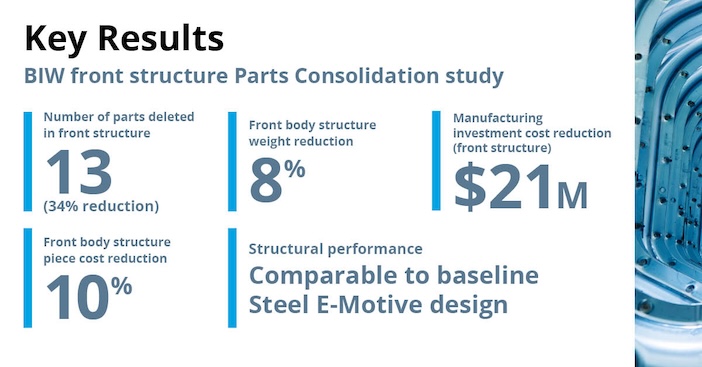
High strength and formability were achieved using hot-stamped press-hardened steel. The study indicated that incorporating tailor-welded blanks into consolidated parts could yield further improvements in cost and weight. WorldAutoSteel says that structural performance appeared to be maintained in the new design, with no differences anticipated in terms of ease of repair.
Ricardo estimated that a US$21 million reduction in total manufacturing investment costs for the front body structure was achievable through simplified tooling and assembly fixtures. Extrapolated across a complete body-in-white and closures, the total reduction could be in the order of US$112 million when accounting for buildings, assembly equipment, and tooling costs.
Ingo Olschewski, director of WorldAutoSteel, said, “Technically challenging studies such as this demonstrate the potential of advanced high-strength steels (AHSS) to address the automotive sector’s most pressing concerns. The study demonstrates ever-greater potential for steel to enable high-performance engineering solutions for future mobility.”