

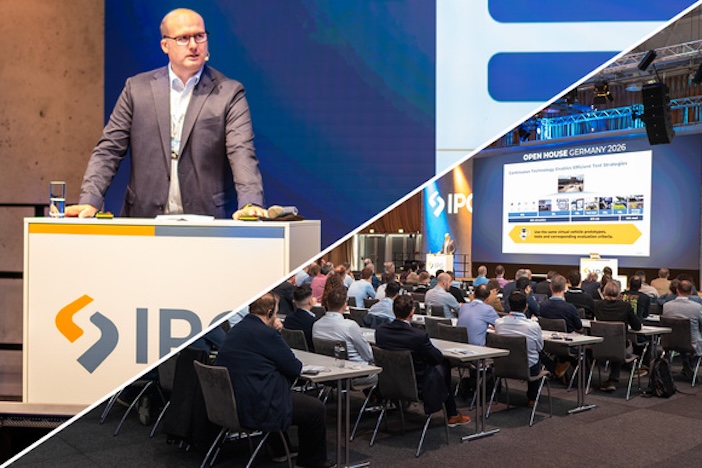
IPG Automotive, a specialist in hardware and software for virtual vehicle development, held its Open House Germany at the Convention Centre Karlsruhe on 17th March. This an annual event is a forum where experts from the automotive industry can gather to discuss and showcase innovations in virtual vehicle development, simulation, and testing strategies.
The 2026 Open House Germany saw attendees showcase how the consistent integration of virtual processes shapes the development of software-defined vehicles, and why virtualisation is a crucial element of modern development strategies.
The event opened with a welcome speech by Steffen Schmidt, president & CEO of IPG Automotive, who stressed that a seamless, digital development process lays the foundation for efficiency, safety and sustainability. He said that the automotive industry faces new challenges, namely highly interconnected systems, rising complexity in functions, and pressure to make testing faster and more scalable. Virtual workflows, from concept to homologation, are decisive to tackle these hurdles, said Schmidt.
These words were followed by a keynote speech from Dr Christopher Wiegand from Holon GmbH, a specialist in autonomous transportation. He highlighted that, due to increasing Operational Design Domain (ODD) requirements and dynamic software scopes, simulation-based homologation serves as a basis to approve autonomous systems. Credible models, consistent data and flexible test infrastructures are essential for this, stated Christopher Wiegand – an idea that was very well received by the participants, according to IPG.
The event programme also featured experts from IPG Automotive, who presented current developments pertaining to seamless test strategies, ADAS/AV validation, and XIL environments. They presented how fully digitalised toolchains, scalable scenarios and AI-based methods can accelerate the validation of new functions and help overcome fragmented development processes. The focus was clearly set on integrated data flows that enable quick iteration cycles and sound decision-making.
More than 25 companies presented their technologies in the trade exhibition area and contributed to the overall event. Event participants, of which there were around 350, seized the opportunity to enjoy a hands-on experience of vehicle-in-the-loop approaches, high-precision sensor technology, new simulation environments, and test systems. The variety of technologies on show illustrated how closely hardware and software solutions are connected.