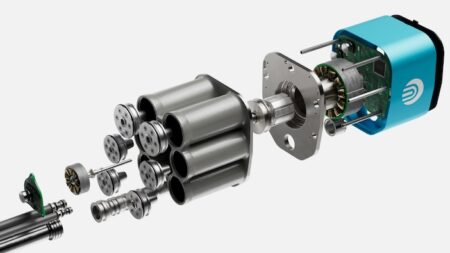



Mercedes-Benz has made steer-by-wire technology available on the updated EQS electric saloon. The production passenger car is now offered with a mechanical decoupling of the steering wheel from the front axle and a redundant signal architecture to ensure continuous lateral control. An electromechanical steering system remains available for the EQS.
The steer-by-wire (SbW) system eliminates direct mechanical linkage between the steering column and the steered wheels. Steering inputs are transmitted electronically via two independent signal paths, with rear-axle steering and targeted wheel-specific braking through the electronic stability programme (ESP) providing a fallback for lateral control in the event of a complete system failure.
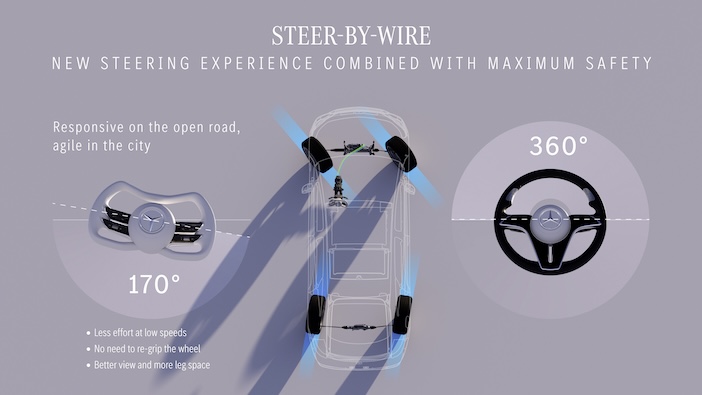
Tyre-road contact feedback is calculated using the restoring forces of the steered wheels and reproduced at the steering wheel, removing the direct transmission of road-surface vibrations to the driver. According to Mercedes-Benz, this approach allows engineers to tune the steering feel on a model-by-model basis while suppressing high-frequency inputs associated with road texture and micro-vibrations.
The steering ratio is variable and adapted to vehicle speed and driving situation. At higher speeds, the rear wheels steer in the same direction as the front wheels to improve stability. The SbW system is available in combination with all EQS powertrains and requires the 10-degree rear-axle steering option.
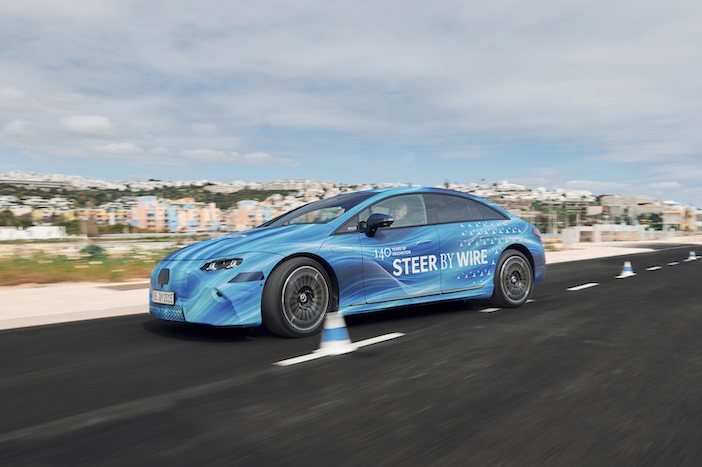
Mercedes-Benz validated the system across more than one million test kilometres on test benches, test tracks and in public road driving. The redundant architecture uses high-precision sensors and two independent control units to ensure steering capability is maintained under fault conditions.
The decoupled steering column allowed engineers to introduce a flatter, more compact steering wheel. Because the airbag can no longer use a closed steering wheel rim as a deployment support structure, Mercedes-Benz developed a new internal support and folding architecture to control airbag shaping during deployment.
The throttle routing, folding pattern and holding points have been designed so that the airbag deploys in a stable and reproducible position without the upper rim, while meeting the same restraint and safety performance requirements as a conventional system.