

Domin, a UK-based developer of active suspension systems, has secured funding to support the development of the next generation of its Domin Suspension technology through Project Activate. The funding will be used to further develop the hydraulic technology into what Domin says will be “the world’s most energy-efficient and lightweight active suspension system for next-generation net-zero vehicles”.
Domin’s funding has been awarded as part of the UK Government’s £4 billion DRIVE35 programme, delivered by the Department for Business and Trade in partnership with the Advanced Propulsion Centre UK and Innovate UK. The project is intended to demonstrate how UK engineering can unlock a more efficient and more scalable approach to active suspensions for the transition to zero-emission transport.
The aim, says Domin, is not only to advance performance, but to show how active suspension can be delivered in a way that is better suited to future vehicle platforms and wider adoption.
Domin’s innovative technology
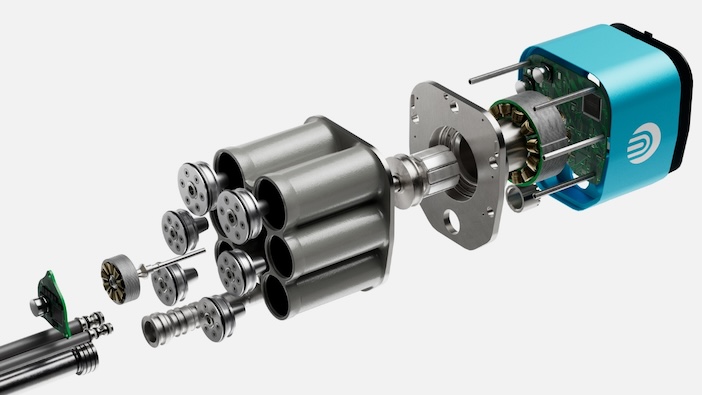
The company claims its suspension technology is unique in the automotive market, because rather than controlling damping through solenoid valves, this system makes use of high-performing servo valves.
The system can shift to higher spring rates for dynamic manoeuvres with what Domin claims is “almost no” power consumption, or the suspension can set a low base spring-rate for comfort when needed, and stiffen it in milliseconds when demanded. The high internal pressures enable a compact, lightweight package.
By combining Domin’s existing hydraulic technology with smart connectivity, they have been able to produce active suspension that can maximise energy efficiency in a lightweight and low energy consuming system.
Domin’s servo valve active suspension technology was a finalist in the Innovation of the Year category in the 2024 Vehicle Dynamics International Awards.
Visit our Videos page to see Sam McKee, suspension design lead at Domin, explain how a system of high-pressure gas springs can provide multiple low-energy modes for an infinite stiffness range, with a reservoir for ride height control and dynamic wheel retract.
A UK supply and innovation chain
Led by Domin, Project Activate will work to advance active suspension technology. The project is focused on creating an energy-efficient and lightweight solution that can be scaled for future net-zero vehicles.
By reducing system mass and energy demand compared with existing active and semi-active systems, the technology is intended to improve vehicle efficiency, extend vehicle range, and reduce lifecycle emissions, while also enhancing ride comfort and handling performance.
Project Activate will build on Domin’s expertise in motion control and will bring together advanced electronics, embedded software, lightweight system integration, metal 3D printing, and optimised control strategies in an integrated suspension architecture. The technology will be integrated and validated on a demonstration vehicle, supported by digital twin modelling and hardware-in-the-loop testing.
Domin believes the project also represents an opportunity to establish a world-leading active suspension capability and supply chain in the UK. Alongside the technical demonstration, Project Activate is expected to stimulate investment in research, development, and manufacturing, while helping create high-value jobs and long-term growth across the automotive supply chain.
Marcus Pont, CEO of Domin, said: “At Domin, our mission is to transform motion control, creating systems that last longer, achieve more and use less, for people everywhere. Project Activate is a clear step forward in that mission, enabling breakthrough energy efficiency and lightweight vehicle dynamics. We’re excited to be working through the DRIVE35 programme to help deliver smarter, more efficient vehicles through world-class UK engineering.”
Simon Jones, CTO of Domin, added: “Project Activate is about rethinking what is possible in automotive motion control systems. By combining advanced software, novel control strategies and our experience in metal 3D printing, we’re creating scalable solutions that enable vehicles to do more with less.”